Living Room Wall Decor: How High To Hang A Painting, And Where
23 August 2026
TL;DR
- The centre of a painting sits between 145 and 152 cm from the floor, lower if everyone is seated.
- Above a sofa: leave 15 to 30 cm above the backrest, and a width of about two thirds of the furniture.
- On a wall, the artwork aims for at least two thirds of its width or height, unless a small format is deliberate.
- Never above a working fireplace or in direct sunlight: heat and UV fade and crack an oil painting.
Hi, I'm Théo! My mother's canvases have hung in places that were never designed for them: a restaurant in Villefontaine kept nineteen of them for three months, a pharmacy, a town hall where one of them stayed for good. A canvas is judged on the wall, at a certain height, above something. The decorators you are about to read put numbers on what those walls already knew.

Régine Gardan
An Award-Winning Artist, 1964 - 2018
- 25+years of painting
- 200+hand-painted canvases
- 35+exhibitions
- 14awards & honours
How High Should You Hang A Painting In A Living Room?
The most widespread convention among galleries and decorators places the centre of the artwork between 145 and 152 cm from the floor. Kelly Cahn, an art advisor and certified appraiser with the Appraisers Association of America, gives 150 cm in Livingetc (December 2025), to be adjusted for proportions and context; the framer Jason Wickens, quoted in the same article, points to the “57-inch rule”, which works out at 145 cm and is the most common in galleries.
One clarification, because you read everywhere that this is supposedly “museum height”: there is no single museum standard. The Smithsonian's accessibility guidelines make no mention of this convention; they place the centre line of labels at 137 cm and put the eye level of an adult man in a wheelchair between 109 and 130 cm. Jason Wickens draws the useful conclusion for a living room: in a room where everyone is seated, you can hang a little lower. Sit down before you hammer in the nail.
Above The Sofa: The Gap And The Two-Thirds Rule
Above a sofa or a console table, two measurements matter. The gap first: Kelly Cahn recommends 15 to 30 cm between the top of the furniture and the bottom of the artwork, Jason Wickens settles on around 30 cm so that the painting “talks” to the seating rather than floating, and the decorator Emily Henderson, quoted by Homes & Gardens (February 2024), starts from around 20 cm.
Then the width: the two-thirds rule holds that the artwork, or the group of artworks, should measure roughly two thirds of the width of the furniture beneath it. Apartment Therapy (November 2025) and Emily Henderson (“half to two thirds”) give the same range. One honest caveat: Apartment Therapy presents it as an answer to the golden ratio, without any historical source; it is a rule of the trade that works, not an ancient law.
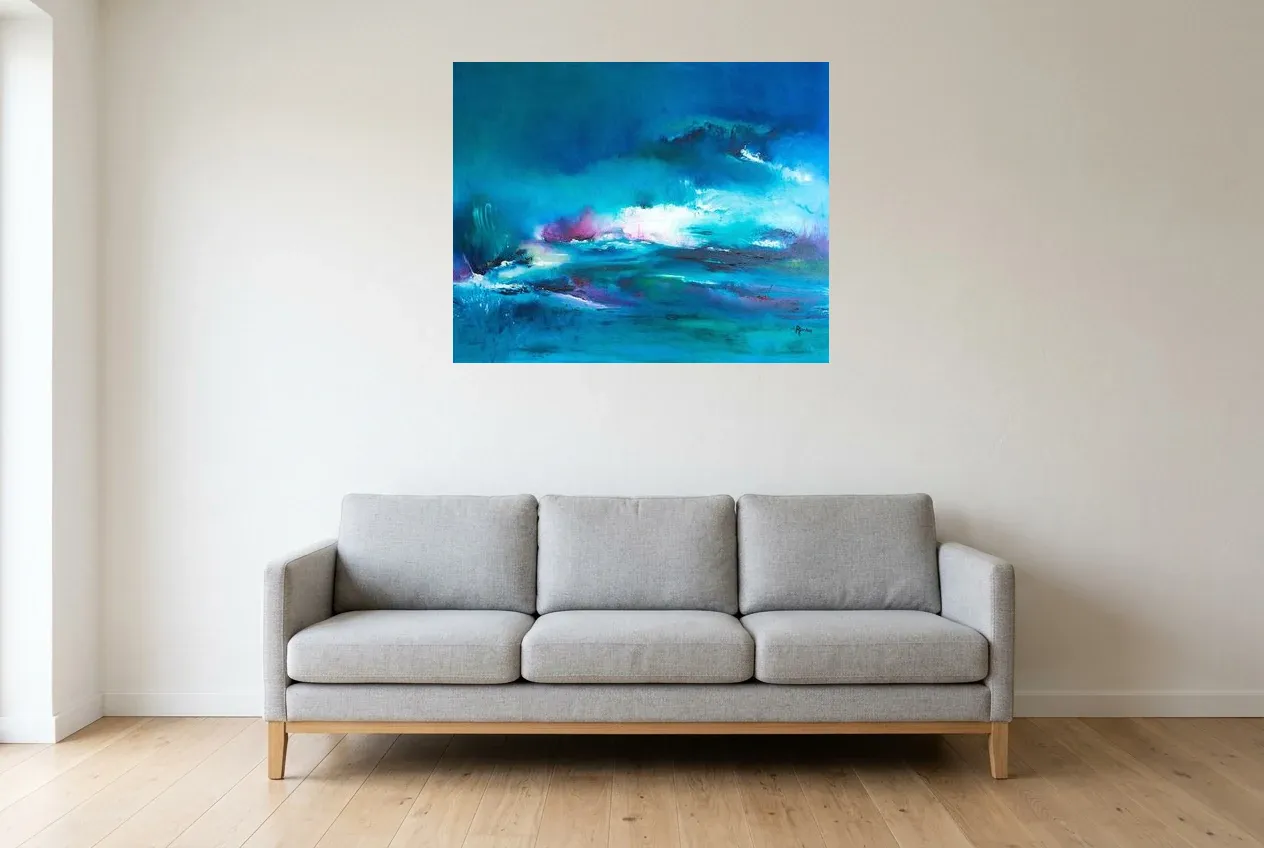
The Size Of The Artwork In Relation To The Wall
The mistake that the designer Cliff Fong (Matt Blacke Inc., Los Angeles) sees most often, in Livingetc, is not knowing how to choose the size of an artwork for a wall. His advice: measure the wall and aim for at least two thirds of its width or its height. He adds that a small format deliberately placed on a large wall can, on the contrary, draw the eye, provided it is a conscious choice and not a painting bought too small.
For an ordinary living room wall, that quickly leads to a large format, and the site's simulator lets you place a canvas on a photo of your own wall before you choose. My mother's canvases go up to 100 cm a side; the large-format collection brings them together, and the page on abstract paintings for the living room gives formats by type of wall.
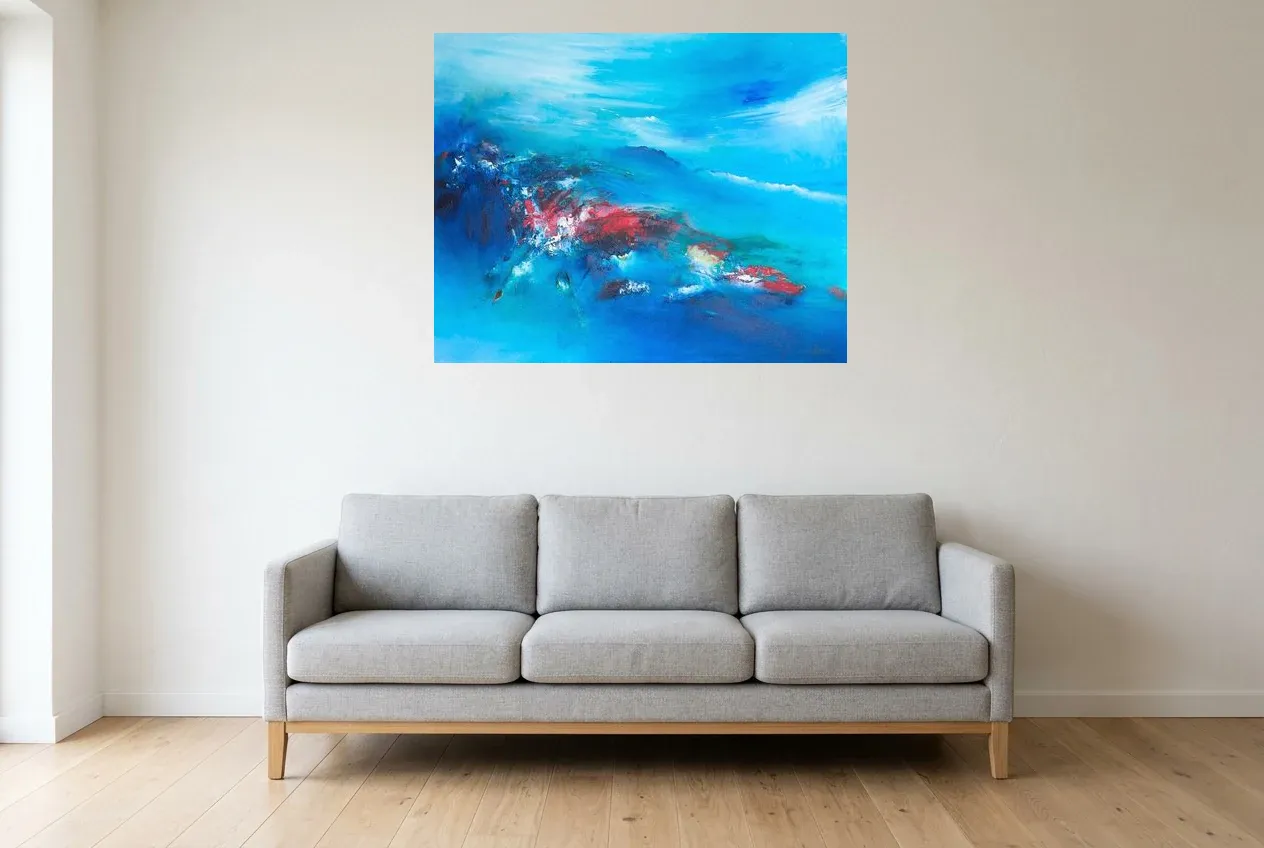
One Large Artwork, Or A Gallery Wall?
Both can be argued for, on one condition each. A strong piece is shown alone, says Cliff Fong: surrounding it with other paintings puts it in competition. If you prefer a gallery wall, Annica Wallin (creative director at Desenio) advises thinking of it as a single large image, and Kelly Cahn suggests centring the whole on a focal point and then building around it.
A trend spotted by Livingetc at the WOW!house show in London (June 2026) offers a third way: paintings suspended from a rail, a picture rail with chains, rather than fixed on a hook. Camilla Clarke (studio Albion Nord) sees an old-fashioned charm in it; the alternative is lighter than a gallery wall and easier to change over time. The fixing method itself remains the one described in how to hang a painting.
Two Places In The Living Room Where You Should Not Hang A Canvas
Above a working fireplace, and in direct sunlight. Kelly Cahn (Livingetc, October 2025) explains that heat alters an artwork over time: changes in the colour of the support and of the paint, fading, warping, cracking. Too much natural light causes glare and fading; if you are set on the wall facing the picture window, she recommends a UV-filtering film on the glass. The rest of the care an oil painting needs is on our page how to care for your painting.
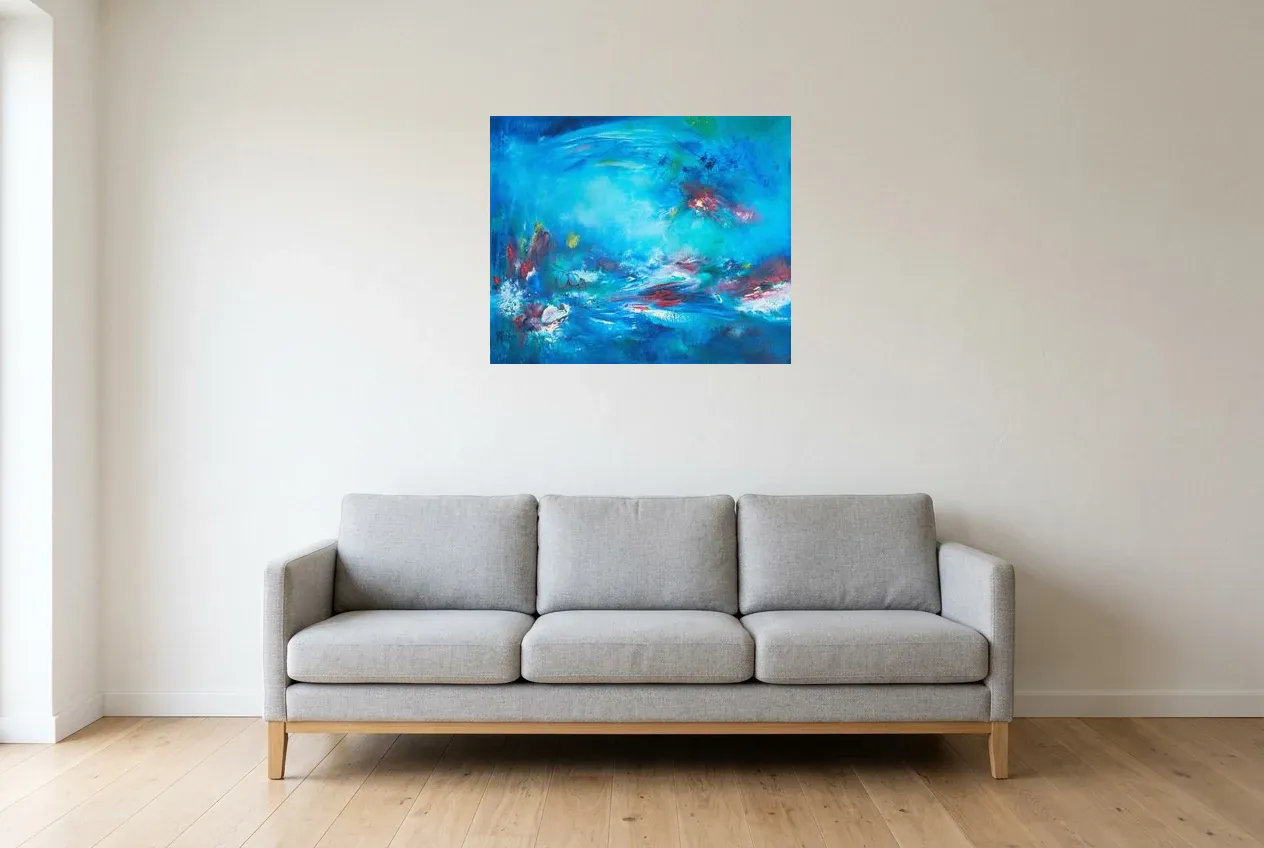
“I love my friend Régine's paintings, the friends who come round to the house are amazed by the quality, the colours, the style, the diversity.”
The Most Common Mistake: Too High
A mistake frequently cited by decorators is hanging too high. Lauren Saab, interior designer (Saab Studios, Dallas), quoted by Livingetc in October 2025, says that artworks hung too high or scattered without rhythm make the room lose its “centre of gravity”. Emily Henderson adds that a piece hung too high or too low without intention “disturbs the eye” and the sense of comfort in the room. The remedy fits in one sentence: sit down, and look.

“Dragon” (60 × 73 cm) is the kind of canvas that holds its own on a medium-sized wall: a vertical, warm format that gives a living room in neutral tones a point of gravity, like the other yellow and gold paintings in the collection. To choose the colour, our guide to the meaning of colours says what each one brings to a room.
And The Choice Of The Artwork Itself?
A study published in the Journal of Vision (Vessel and Rubin, 2010) measured something useful for anyone hesitating in front of an abstract canvas: in its main experiment (11 observers), agreement between two people on what they find beautiful drops from 0.46 for photographs of real scenes to 0.20 for computer-generated abstract images, while each person remains just as consistent in their own tastes. In other words, on abstract art, personal taste carries far more weight than it does on a photograph. There is no shared right choice: there is yours. The guide to choosing a painting to match your personality starts from there.
Frequently Asked Questions
How High Should You Hang A Painting Above A Sofa?
Leave 15 to 30 cm between the top of the backrest and the bottom of the artwork (Kelly Cahn, Livingetc), and centre the artwork on the sofa. Its width, alone or as a group, should aim for two thirds of the sofa's.
Should A Painting Be Centred On The Wall Or On The Furniture?
On the furniture it sits above: that is what the eye connects it to. A painting centred on the wall but offset from the sofa appears to float, which is the effect Jason Wickens describes in Livingetc.
What Size Of Painting For A Large Living Room Wall?
At least two thirds of the width or the height of the wall, according to Cliff Fong. A 100 × 80 cm canvas holds an ordinary wall on its own; below 60 cm, you need a narrow wall or a group.
Can You Hang An Oil Painting Above A Fireplace?
Not if it is in use. Heat fades, warps and cracks a canvas over time, according to the art advisor Kelly Cahn. A decorative fireplace, unlit, does not pose this problem.
From The Wall To The Painting
You have the height, the gap and the size. That leaves the canvas. Browse the collection by colour or by horizontal format, the one that follows the line of a sofa, and if the living room still feels cold, read what makes a living room cosy.